First-home essentials
The mistake most new homeowners make is buying everything at once. You end up with a dining table before you have a working kitchen, or a guest-room bed before you can cook a meal.
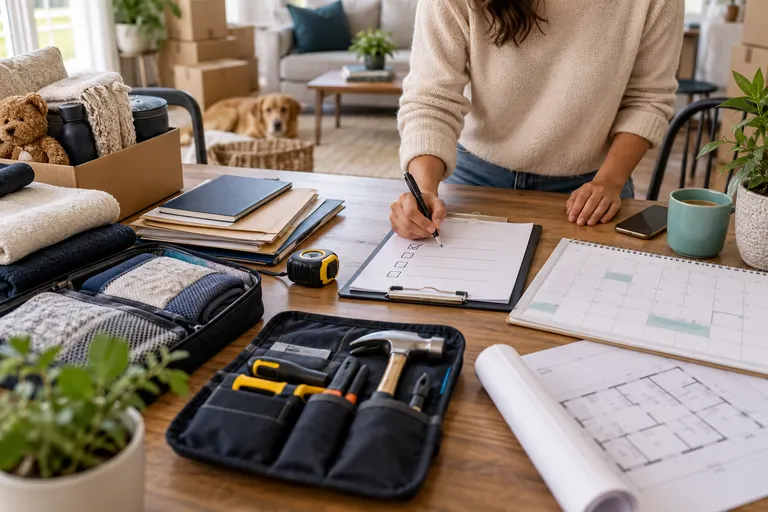
The Functional-Zone Method
The mistake most new homeowners make is buying everything at once. You end up with a dining table before you have a working kitchen, or a guest-room bed before you can cook a meal. Instead, buy by function and sequence.
The rule: furnish and equip each zone in the order you will use it. Your home has four essential zones: 1. Sleep and hygiene, bedroom, bathroom 2. Food and waste, kitchen, utility 3. Living and safety, living area, entry, storage 4. Work and records, home office, document storage
Within each zone, buy only what you need for the first 30 days. After that, you will know what you actually use.
Checklist: What to Buy First (by Zone)
Zone 1: Sleep and Hygiene (Day 1-3)
| Item | Why you need it | Source to confirm |
|---|---|---|
| Mattress and bed frame | You need to sleep | Personal comfort; no outside source needed |
| Pillows and bedding | Hygiene and comfort | Personal choice |
| Towels, washcloths | Basic hygiene | Personal choice |
| Toilet paper, hand soap, trash can | Immediate sanitation | EPA (2024) for waste-disposal guidance |
| Shower curtain and liner | Prevents water damage | No outside source needed |
| Plunger and drain snake | Prevents urgent plumbing calls | No outside source needed |
| First-aid kit | Cuts, burns, falls happen immediately | American Red Cross (2024) for contents |
| Smoke alarm battery (if missing) | Life safety; required by code | NFPA (2025): at least one per level and inside each sleeping room |
| Carbon monoxide alarm battery | Required on floors with sleeping areas | NFPA (2025) |
Zone 2: Food and Waste (Day 1-7)
| Item | Why you need it | Source to confirm |
|---|---|---|
| Trash cans and bags | Hygiene and pest prevention | EPA (2024) |
| Dish soap, sponge, drying rack | You must wash dishes | No outside source needed |
| One pot, one pan, one knife, one cutting board | You must cook | No outside source needed |
| Plates, bowls, glasses, utensils for 2 people | You must eat | No outside source needed |
| Can opener | Many first meals come from cans | No outside source needed |
| Fire extinguisher (Class A for general, Class K for kitchen) | Required by code on every floor | NFPA (2025) |
| Microwave or kettle | Quick meals without a full cooktop | No outside source needed |
| Coffee maker or tea kettle (if you drink either) | Morning routine | No outside source needed |
Zone 3: Living and Safety (Day 7-30)
| Item | Why you need it | Source to confirm |
|---|---|---|
| Flashlight and batteries | Power outages are common in first month | FEMA (2024) |
| Battery-powered radio | Urgent alerts if power is out | FEMA (2024) |
| Basic tool kit (hammer, screwdrivers, pliers, wrench, tape measure) | You will need to assemble furniture and fix things | No outside source needed |
| Vacuum cleaner or broom | Dust from moving is a health hazard | No outside source needed |
| Curtains or blinds for bedroom windows | Privacy and sleep quality | No outside source needed |
| Door mat | Reduces dirt tracked in | No outside source needed |
| Trash and recycling bins for curb pickup | Required by local ordinance | Check with local municipal or private provider (EPA, 2024) |
Zone 4: Work and Records (Day 30+)
| Item | Why you need it | Source to confirm |
|---|---|---|
| Desk and chair | You need a surface for paperwork | No outside source needed |
| File box or filing cabinet | Essential documents must be organised | FEMA (2024) recommends home inventory documentation |
| Home inventory (photos or video of all rooms) | For insurance claims | FEMA (2024); update after major purchases or annually |
| Document binder | See Documents section below | No outside source needed |
Plan: The 30-Day Sequencing Rule
You do not need a full house on day one. Use this sequencing plan:
Week 1: Zone 1 (sleep and hygiene) + Zone 2 (food and waste). You can sleep, wash, eat, and clean.
Week 2: Zone 3 (living and safety). Add lighting, crisis supplies, basic tools, window coverings, and cleaning equipment.
Week 3-4: Zone 4 (work and records). Set up your document system, home inventory, and any work-from-home essentials.
After 30 days: Buy only what you have missed. If you have not needed it in a month, you probably do not need it yet.
Documents: What to Keep and Where
Your first-home document binder should contain:
| Document | Why you need it | Source to confirm |
|---|---|---|
| Lease or deed | Proof of occupancy and ownership | Signed document; keep original in fireproof safe |
| Renter’s or homeowner’s insurance policy | Required by most leases and mortgages | Insurance Information Institute (2024) |
| Utility connection confirmations | Proof of service start dates | Provider emails or letters |
| Home inspection report (if purchased) | Know your home’s systems and issues | Real estate contract (2025) |
| Appliance manuals and warranties | Needed for repair and claims | Manufacturer; warranty expiration is typically 1-5 years |
| Home inventory (photos/video) | For insurance claims | FEMA (2024) |
| Emergency contact list | See Emergency Kit section below | FEMA (2024) |
Store originals in a fireproof safe or safety deposit box. Keep digital copies in a password-protected cloud folder.
Deadline: What Must Happen and When
Utilities and Official Changes
| Task | Deadline | Source |
|---|---|---|
| Utility setup (electricity, gas, water, internet) | 2-4 weeks before move-in | Local provider; schedule early |
| Mail forwarding | Day of move or up to 14 days before | USPS (2025); valid for up to 12 months |
| Change of address with banks, employers, insurers | Within 1-2 weeks of move | Individual institutions |
| Voter registration | 15-30 days before next election [varies by state] | USA.gov (2025) |
| Driver’s license address update | 10-30 days after move [varies by state] | DMV.org (2025) |
| Vehicle registration address update | 10-30 days after move [varies by state] | DMV.org (2025) |
| Pet license and microchip update | Within 30 days [varies by locality] | AVMA (2024) |
| School enrollment | Before first day of school | Local school district (2025); requires proof of residency, immunisation records, birth certificate |
Recurring Safety and Maintenance
| Task | Deadline | Source |
|---|---|---|
| Smoke alarm battery replacement | At least once per year or when chirping | NFPA (2025) |
| Carbon monoxide alarm battery replacement | At least once per year or when chirping | NFPA (2025) |
| First-aid kit expiration check | Every 6 months | American Red Cross (2024) |
| Emergency plan review | Every 6 months with all household members | FEMA (2024) |
| Home inventory update | After major purchases or annually | FEMA (2024) |
| HVAC filter replacement | Every 3 months | DOE (2024) |
| Water heater temperature check | 120°F (49°C) to prevent scalding | DOE (2024) |
| Pest control initial inspection | Within first month of occupancy | NPMA (2024) |
Emergency Kit: Minimum for 72 Hours
FEMA (2024) specifies that every household should have a kit that can sustain everyone for at least three days without outside help. This is not optional, it is the standard for home safety.
Core Supplies
| Supply | Amount | Why |
|---|---|---|
| Water | 1 gallon per person per day for 3 days | FEMA (2024) |
| Non-perishable food | 3-day supply per person | FEMA (2024) |
| Manual can opener | To open food without power | FEMA (2024) |
| Flashlight | Light without fire risk | FEMA (2024) |
| Battery-powered radio | Urgent alerts when power is out | FEMA (2024) |
| Extra batteries | For flashlight and radio | FEMA (2024) |
| First-aid kit | See contents below | American Red Cross (2024) |
| Whistle | To signal for help | FEMA (2024) |
| Dust mask | For debris after a disaster | FEMA (2024) |
| Plastic sheeting and duct tape | To shelter in place | FEMA (2024) |
| Moist towelettes | Hygiene without water | FEMA (2024) |
| Wrench or pliers | To shut off utilities | FEMA (2024) |
| Local maps | Navigation without GPS | FEMA (2024) |
| Cell phone with charger and backup battery | Communication | FEMA (2024) |
First-Aid Kit Contents
Per the American Red Cross (2024): adhesive bandages, antiseptic wipes, antibiotic ointment, pain relievers, tweezers, scissors, medical gloves, instant cold pack, emergency blanket.
Emergency Contact List
Write these numbers on paper (do not rely on a phone): - Local police non-emergency - Fire non-emergency - Poison control (USA: 1-800-222-1222) - Utility emergency numbers (gas leak, power outage, water main break) - Landlord or property management emergency number - Nearest hospital emergency room - Nearest urgent care centre - Pharmacy - Veterinarian (if you have pets) - FEMA helpline (USA: 1-800-621-3362) - Disaster distress helpline (USA: 1-800-985-5990)
Keep one copy in your kit and one taped inside a kitchen cabinet. Share it with all household members.
Frequently Asked Questions
What if I rent? Do I still need a home inventory?
Yes. FEMA (2024) recommends a home inventory for all households, not just owners. It documents your possessions for renter's insurance claims in case of fire, theft, or natural disaster. Take photos or video of every room and store them off-site (cloud or safety deposit box).
How do I know which utility providers serve my address?
Check your local government website or call the city hall planning department. For electricity, gas, and water, most areas have a single regulated provider. For internet, the FCC (2024) maintains a broadband map at fcc.gov/maps. Schedule connection 2-4 weeks before move-in.
When should I change my locks?
Immediately upon move-in. Previous owners or tenants may have copies of the key. Hire a locksmith or replace the cylinder yourself. This is not required by code, but it is a basic security step.
Do I need a fire extinguisher in a rental?
Yes. NFPA (2025) requires at least one fire extinguisher on every floor. In a rental, your landlord may provide one, but if not, you are responsible. Buy a Class A extinguisher for general use and a Class K for the kitchen. Check the gauge monthly.
Read next
-
Moving-house checklist
A moving-house checklist turns a chaotic set of tasks into a sequenced, verifiable plan.
-
Home-maintenance calendar
A home-maintenance calendar turns recurring inspections and tasks into a schedule tied to the season, the household system, and the risk of failure.
-
Build a household information folder
A household information folder is the single place where everyone in your home can find the contacts, documents, and instructions needed during a crisis, a move, or after a major life event.
-
Travel preparation
Travel preparation means building a source-verified plan that covers documents, health, security, home, and work before you leave.