Build a home emergency kit
Your home emergency kit is not a static box you fill once. It is a layered system built around four priorities, in order: immediate safety, stabilisation, records, and follow-up.
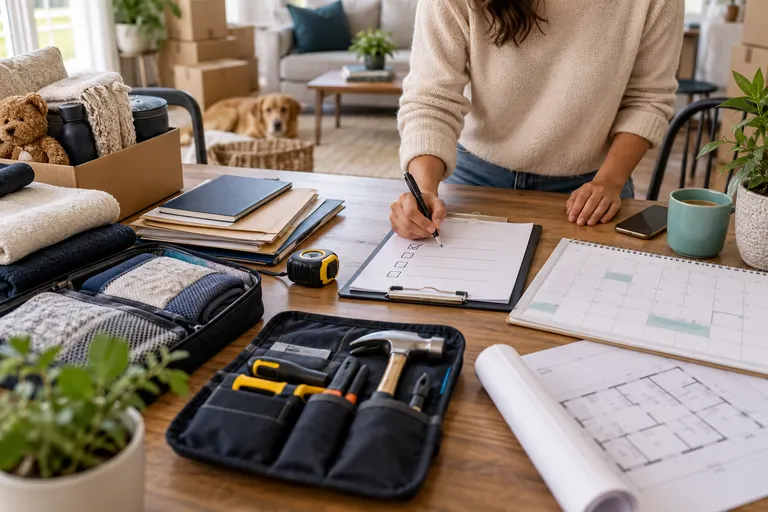
The core method: plan in layers by priority
Your home emergency kit is not a static box you fill once. It is a layered system built around four priorities, in order: immediate safety, stabilisation, records, and follow-up. This sequence comes from the FEMA Ready Campaign (2024) and the Red Cross emergency preparedness framework. The method works for any household size, location, or hazard type.
Start with the life-support layer, then add stabilisation supplies, then documents, then the refresh schedule. Never skip a layer; each depends on the one before it.
Checklist: the four-layer kit
Every item below exists because a named official source requires or recommends it for a specific reason. Do not add items until you verify that they meet the same standard.
Layer 1: Immediate safety (first 72 hours)
| Item | Why | Source |
|---|---|---|
| Water: 3.78 litres (1 gallon) per person per day for 3 days minimum | Drinking and basic sanitation; 14 days recommended | FEMA Ready Campaign, 2024 |
| Food: 3-day supply of non-perishable food per person | Calorie intake without cooking or refrigeration | FEMA Ready Campaign, 2024 |
| Manual can opener | Access to canned food without power | Red Cross Emergency Kit, 2024 |
| Flashlight with extra batteries | Light without fire risk (candles are prohibited by FEMA for home kits) | FEMA, 2024 |
| Battery-powered or hand-crank radio (NOAA Weather Radio preferred) | Receive emergency alerts when mobile networks fail | FEMA, 2024 |
| First aid kit | Treat minor injuries before professional help arrives | FEMA, 2024; Red Cross, 2024 |
| Whistle | Signal for help without shouting | FEMA, 2024 |
| Dust mask | Filter contaminated air after structural damage or fire | FEMA, 2024 |
| Wrench or pliers | Turn off utilities (gas, water) if instructed by authorities | FEMA, 2024 |
| Cell phone with charger and backup battery | Communication and information access | FEMA, 2024 |
| Cash in small bills | Purchase supplies when card systems are down | FEMA, 2024 |
Decision rule: If you cannot store the full 3-day supply for every household member, prioritise water and first aid. A 1-day supply of water per person is the absolute minimum; below that, the kit cannot sustain life until help arrives.
Layer 2: Stabilisation (days 4-14)
| Item | Why | Source |
|---|---|---|
| Additional water and food for 11 more days | FEMA recommends 14 days total for households in hazard-prone areas | FEMA, 2024 |
| Prescription medication: 14-day minimum supply in original containers | Many pharmacies close during disasters; original containers prove ownership and dosage | FEMA, 2024 |
| Moist towelettes, garbage bags, plastic ties | Sanitation when plumbing is unavailable | FEMA, 2024 |
| Local maps (paper) | Navigate when GPS and cell service are down | FEMA, 2024 |
| Multi-purpose tool | Cutting, opening, minor repairs | Red Cross, 2024 |
| Extra clothing and sturdy shoes | Protection from debris and weather | Red Cross, 2024 |
Decision rule: Add Layer 2 items only after Layer 1 is complete and stored in a single, accessible container. If you live in an area with frequent flooding, hurricanes, or earthquakes, FEMA recommends prioritising the full 14-day supply (FEMA, 2024).
Layer 3: Records and communication
| Item | Why | Source |
|---|---|---|
| Copies of important documents in a waterproof container | Prove identity, insurance, and property ownership without originals | FEMA, 2024 |
| Emergency contact list (hard copy) | Phone numbers for family, out-of-state contact, and local emergency services | FEMA, 2024 |
| Pet supplies (food, water, leash, carrier, vaccination records) | Pets are household members; shelters may require proof of vaccinations | Red Cross, 2024 |
Document binder contents (recommended by FEMA, 2024):
- Birth certificates
- Marriage certificate or divorce decree
- Social Security cards (US) or equivalent national ID numbers
- Passports
- Insurance policies (health, home, auto)
- Property deeds or rental agreements
- Vehicle titles
- Wills and powers of attorney
- Medical directives
- Bank and credit card account numbers
Decision rule: Keep originals in a fireproof safe or safe-deposit box. The emergency kit holds copies only. Update the binder every 6 months when you rotate supplies.
Layer 4: Maintenance and refresh
| Action | Frequency | Source |
|---|---|---|
| Replace water | Every 6 months | FEMA, 2024 |
| Check food expiration dates | Every 6 months | FEMA, 2024 |
| Test batteries and replace as needed | Every 6 months | FEMA, 2024 |
| Check medication expiration dates | Every 6 months | FEMA, 2024 |
| Review and update contact list | Every 6 months | FEMA, 2024 |
| Practice a household drill | Annually | FEMA, 2024 |
Decision rule: Set a recurring calendar reminder for the same day every 6 months (e.g., daylight saving time changes). A kit that is not refreshed is not reliable.
Plan: tailor to your local hazards
A generic kit covers the basics, but your location determines which hazards matter most. FEMA’s “Know Your Risk” tool (FEMA, 2024) identifies local threats by zip code or region.
- Flood zone: Add waterproof bags for documents, extra water purification tablets, and a pump or siphon.
- Earthquake zone: Add sturdy shoes near the bed, a wrench to shut off gas, and a heavy-duty flashlight that stays in a fixed location.
- Hurricane zone: Add tarps, rope, plywood for window protection, and a full 14-day supply of food and water.
- Wildfire zone: Add N95 masks, go-bags for each person (pre-packed for immediate evacuation), and a paper map with evacuation routes.
- Cold climate: Add blankets, hand warmers, a camp stove (with fuel stored safely), and extra warm clothing.
Decision rule: If your area has multiple hazards, prepare for the most likely one first. A kit that covers hurricanes also covers many flood scenarios. Do not try to build a universal kit for every hazard at once; you will run out of space and budget.
Documents: what to copy and where to store
| Document type | Why it is in the kit | Verification source |
|---|---|---|
| Passport (copy) | Proof of citizenship and identity; required for emergency travel | US State Department, 2024 |
| Insurance policies (copies) | Claim filing after property loss | FEMA, 2024 |
| Medical records (copies of prescriptions, allergies, conditions) | Continuity of care at shelters or clinics | CDC, 2024 |
| Emergency contact list | Contacts for family, out-of-state relative, and local emergency services | FEMA, 2024 |
| Pet vaccination records | Required by many emergency shelters | Red Cross, 2024 |
Store all copies in a single waterproof container (e.g., a sealed plastic bag inside a waterproof box). Label the container clearly. Do not store the originals in the kit; keep them in a fireproof home safe or safe-deposit box.
Deadline: when to build and when to refresh
- Build by: The end of this week. A partial kit is better than no kit. Start with Layer 1.
- Refresh every: 6 months. Use daylight saving time changes as your trigger (FEMA, 2024).
- Replace water and food: Every 6 months. Manufacturer expiry dates are set for taste, not safety, but FEMA recommends replacement to avoid degradation from temperature cycling (FEMA, 2024).
- Check medications: Every 6 months. Expired medications lose potency; replace before the expiration date.
- Update documents: Every 6 months, or immediately after a life change (marriage, divorce, birth, death, move).
Decision rule: If you cannot do a full refresh, at minimum check water and medication dates. Those are the two items that can fail silently and cause harm.
Moving: how to transfer your kit
When you move to a new home, the kit needs a full reset, not just a transfer.
- Assess new hazards. Use FEMA’s “Know Your Risk” tool for the new location (FEMA, 2024). A kit built for a flood zone is incomplete in a wildfire zone.
- Update documents. Change your document binder to reflect the new address on insurance policies, vehicle titles, and voter registration.
- Replace stored water. Water in plastic containers should not be moved long distances; it may have micro-cracks. Replace with fresh water at the new location.
- Re-evaluate storage location. The kit should be in a cool, dry place near an exit, not in a basement that could flood or an attic that could overheat.
- Update your emergency contact list. Add local emergency numbers for the new area and remove old ones.
Decision rule: If you move to a different climate zone (e.g., from inland to coast), discard food and water that may have been stored outside recommended temperature ranges (below 75°F for long-term storage). Start fresh.
Frequently Asked Questions
How much water does one person actually need per day?
FEMA recommends 3.78 litres (1 gallon) per person per day for drinking and basic sanitation (FEMA, 2024). This covers drinking, cooking, and hygiene. Do not reduce it unless you have a verified alternative water source (e.g., a well with a hand pump).
Can I use candles instead of a flashlight?
No. FEMA explicitly advises against candles in home emergency kits due to fire risk, especially after a disaster when gas lines may be damaged (FEMA, 2024). Use a flashlight with extra batteries.
How often should I replace the food in my kit?
Replace non-perishable food every 6 months, or before the manufacturer’s expiry date if that comes sooner (FEMA, 2024). Freeze-dried food can last 3-5 years if stored below 75°F, but you must still check for package damage and temperature exposure.
What if I have a medical condition not covered by a generic kit?
Add a medical alert card listing your condition, allergies, and emergency contacts. Store a 14-day supply of prescription medications in original containers (FEMA, 2024). For mobility aids, oxygen, or dialysis supplies, contact your local emergency management office for condition-specific add-ons; no single source covers all needs, but your local agency can advise.
Read next
-
Family emergency contact plan
A family emergency contact plan has three non-negotiable components: two designated meeting points, one out-of-area contact, and a written card carried by each household member.
-
Administrative steps after a death
The days after a death are disorienting. This guide gives you a sequence of administrative tasks in legal-priority order, a document checklist, deadlines, and a 72-hour emergency kit.
-
Prepare home for a new baby
Before anything else, set up the infant sleep area to meet the American Academy of Pediatrics (AAP) safe sleep guidelines.
-
Plan what is needed
Evidence-based practical planning means turning an outcome you want, a smooth move, a safe trip, a finished project, into a set of dependencies, owners, evidence and review points.